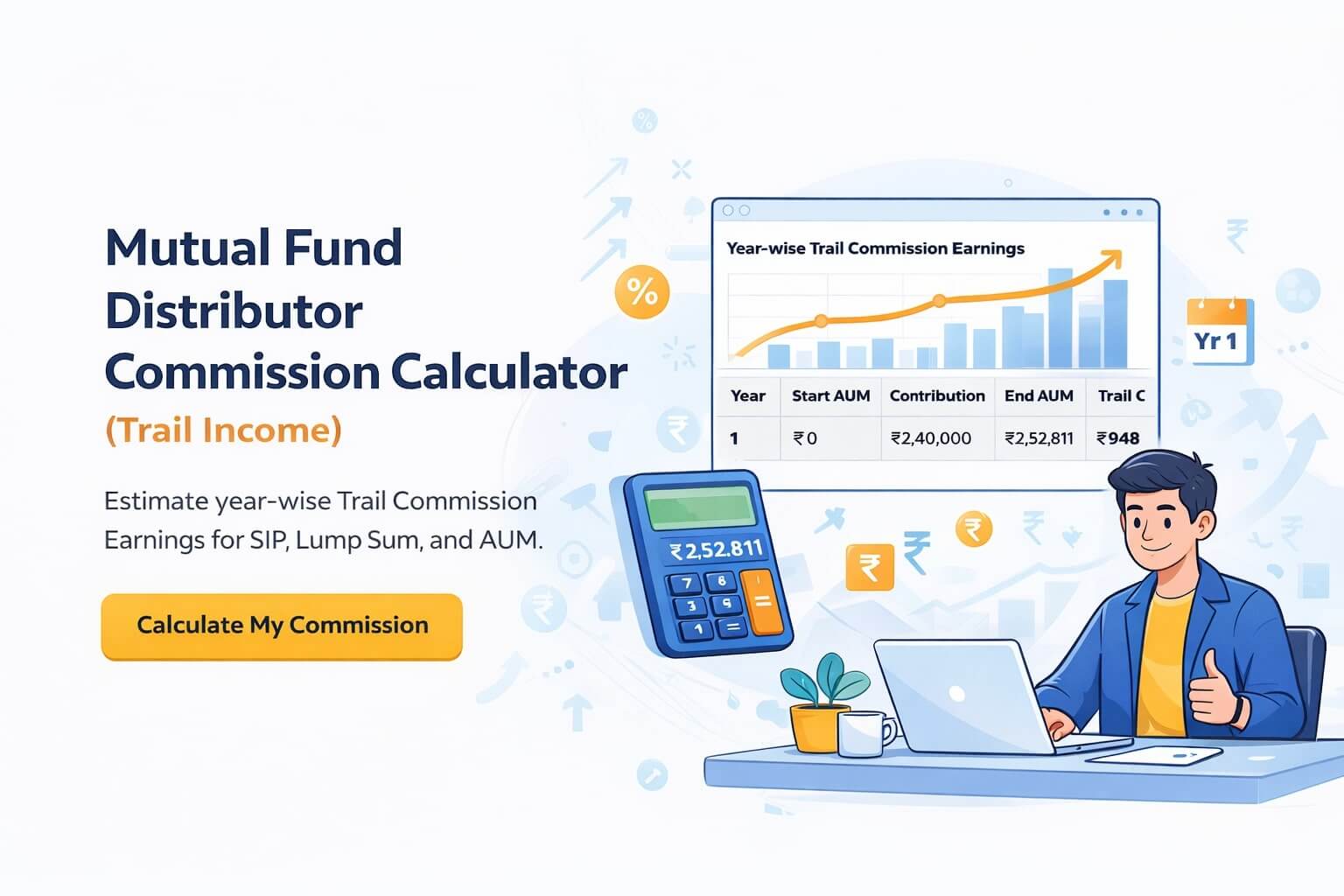
Mutual fund distributor commission, explained.
How mutual fund distributor commission (also called agent commission) works in India. Upfront vs trail, year-wise structure, AMC payouts, and how to estimate earnings.
Updated October 2026 for the 2 percent TDS rule under the Income-tax Act, 2025 and the SEBI B30 and women investor incentive regime (effective 1 March 2026).
Mutual fund distributor commission, also called mutual fund agent commission, is the income an MFD or agent earns for selling and servicing mutual fund schemes. It comes in two forms: upfront commission paid once at the time of investment, and trail commission paid every year as a percentage of the assets the investor holds.
Trail rates in India usually fall between 0.20 percent and 1.00 percent per year. Most professional distributors build their long term income from trail commission.
The commission chart by fund category lists typical equity, debt and hybrid trail rates with rupee figures on ₹50 lakh and ₹1 crore of AUM. For what each AMC actually paid out, see how to read the AMFI commission disclosure.
Mutual fund distributors, also called mutual fund agents in everyday usage, earn their income through commissions paid by asset management companies, commonly known as AMCs. For anyone entering the mutual fund distribution business, understanding how distributor commission works is essential for building a sustainable long term income.
This guide explains mutual fund distributor commission in simple terms. It covers how the commission is calculated, the types of commission, the difference between agent commission and distributor commission, and why trail commission plays a key role in long term earnings.
What is mutual fund distributor commission?

Mutual fund distributor commission is the payment a distributor receives for selling and servicing mutual fund investments. This commission is paid by the AMC and not directly by the investor.
The commission is usually built into the total expense ratio of a mutual fund scheme. Investors do not see a separate charge, but the distributor is compensated for onboarding clients, handling documentation, and providing ongoing service.
In India, mutual fund distribution and commission structures are governed by SEBI regulations and industry guidelines from AMFI.
Who is eligible to earn distributor commission?
To earn mutual fund distributor commission in India, a person or entity must:
- Hold a valid AMFI Registration Number (ARN)
- Pass the NISM Series V-A certification exam, or Series V-D, which covers mutual funds and SIFs together
- Be empanelled with one or more AMCs
- Follow all regulatory and compliance requirements
Once registered, the distributor becomes eligible to receive commissions on investments made through their ARN. Distributing Specialised Investment Funds needs a separate AMFI registration as well, set out in our SIF distributor guide.
Commission as a sub-distributor versus on your own ARN
Many distributors who hold their own ARN still transact under a platform’s or a national distributor’s principal ARN, with their code recorded in the sub-distributor field. AMCs pay commission to the ARN on the folio, so where your business sits decides how the money reaches you.
| Under a principal ARN | On your own ARN | |
|---|---|---|
| Who the AMC pays | The principal ARN holder | You, directly |
| What reaches you | The share agreed with the principal | The full commission on your folios |
| AMC empanelment | Covered by the principal | Needed with each AMC you sell, through each fund house’s portal |
| Statements and reconciliation | Provided on the principal’s platform | Run by you or your own software |
Moving an existing book from a principal ARN to your own follows AMFI’s transfer rules. A whole-book transfer keeps trail flowing, at the lower of the two commission rates, if the principal certifies that your entire AUM is moving. Clients who move one at a time through the change of broker form wait out a 12-month cooling-off before trail can resume. Our change of broker guide sets out both routes and links the CAMS and KFintech forms.
Mutual fund agent commission and distributor commission: are they the same?
In simple terms, yes. Mutual fund agent commission and mutual fund distributor commission refer to the same earnings.
SEBI and AMFI use the formal term distributor. In real conversation, the same person is often called a mutual fund agent, an MF agent, or an MFD. Investors and aspiring professionals also search online using both terms, so you will see them used interchangeably across blogs, calculators, and rate cards.
Whether you call it agent commission, MFD commission, or distributor commission, it works the same way: the AMC pays the commission, and it is split between an upfront component at the time of sale and a trail component for as long as the investor stays invested.
Types of mutual fund distributor commission
1. Upfront commission
Upfront commission, sometimes called the agent upfront commission, is a one time payment made shortly after an investment is completed. It is calculated as a percentage of the investment amount.
Example: If an investor invests ₹1,00,000 and the upfront commission rate is 1 percent, the distributor or agent earns ₹1,000 as a one time payment.
In recent years, regulators have encouraged a shift away from upfront heavy models to reduce mis selling and promote long term investor interest.
2. What is trail commission in mutual funds?
Trail commission in mutual funds is the ongoing commission an AMC pays a distributor every year for as long as the investor stays invested, calculated as a percentage of that investor’s assets under management (AUM). It is also called ongoing agent commission. The AMC pays it out of the scheme’s expense ratio, which is why it applies to regular plans and direct plans carry none.
Example: If a distributor or agent manages ₹50 lakh of AUM and the trail rate is 0.75 percent per year, the agent earns approximately ₹37,500 annually. This amount is usually paid monthly or quarterly.
Trail commission forms the backbone of long term income for most professional mutual fund distributors and agents.
Why trail commission is more important than upfront commission
Trail commission is considered healthier for both distributors and investors because:
- Income is recurring and predictable
- Distributor focus shifts to long term client retention
- Earnings grow as AUM grows
- Business becomes more stable over time
A distributor who builds long term relationships can earn steady income even without continuously onboarding new clients.
How mutual fund distributor commission is calculated
Commission calculation depends on multiple factors, including:
- Scheme category such as equity, debt, or hybrid
- AUM value
- Applicable commission rate
- Duration for which the investment is held
Trail commission is often calculated using average AUM. In real systems, AMCs may use daily average assets, which means exact payouts can vary slightly month to month.
Because of these variables, distributors often use estimation tools rather than manual calculations.
Understanding year wise commission structure
Many AMCs define trail commission rates based on how long the investment stays active. A common structure looks like this:
- Year 1 commission rate
- Year 2 commission rate
- Year 3 commission rate
- Year 4 onwards commission rate
For example, an AMC may offer 0.75 percent trail for the first three years and 0.60 percent from the fourth year onwards. This structure rewards distributors for long term client retention rather than short term sales.
Example: ₹20,000/month SIP at 10% p.a. return
| Year | Approx. AUM | Trail Rate | Annual Commission |
|---|---|---|---|
| 1 | ₹2.5L | 0.75% | ₹1,875 |
| 2 | ₹5.2L | 0.75% | ₹3,900 |
| 3 | ₹8.1L | 0.75% | ₹6,075 |
| 4 | ₹11.3L | 0.60% | ₹6,780 |
| 5 | ₹14.8L | 0.60% | ₹8,880 |
Commission grows as AUM grows, even with a lower rate in later years.
How SIP investments affect distributor commission
SIPs build AUM gradually over time. Each monthly installment starts earning returns as soon as it is invested. Because of this, early SIP installments stay invested longer, AUM grows month by month, and trail commission increases gradually.
In the first year, end AUM is often higher than the total SIP amount invested because of market returns and compounding. This directly impacts trail commission earnings.
Mutual fund commission chart by fund category
Actual commission rates vary by AMC, scheme, and distributor category. Approximate ranges are:
| Fund Type | Trail Rate (approx / yr) | On ₹50L AUM | On ₹1Cr AUM |
|---|---|---|---|
| Equity | 0.50% to 1.00% | ₹25K to ₹50K | ₹50K to ₹1L |
| Debt | 0.20% to 0.60% | ₹10K to ₹30K | ₹20K to ₹60K |
| Hybrid | 0.40% to 0.80% | ₹20K to ₹40K | ₹40K to ₹80K |
These numbers are indicative and can change based on AMC policies and regulatory updates.
B30 vs T30: how geography affects mutual fund distributor commission
AMFI categorises Indian cities into two buckets: T30 and B30. T30 refers to the top 30 cities by mutual fund AUM (the metro and large-tier-one urban centres). B30 refers to the rest of the country, the smaller cities and towns where mutual fund penetration is much lower.
To encourage geographic spread of mutual fund inflows, AMCs have long paid additional commission to distributors who brought in fresh inflows from B30 locations. That mechanism was reset by SEBI at the end of 2025 and a new framework took effect from 1 March 2026. If you are still working off the old B30 slab logic, this section is the part to read carefully.
The 2026 incentive regime (effective 1 March 2026)
Under the reset framework, the additional incentive is no longer a broad B30 uplift on all inflows. It is a targeted incentive for bringing genuinely new investors into mutual funds, and it now covers two categories:
- New investors from B30 cities. First-time individual investors, identified as new at the PAN level, from cities beyond the top 30 by AUM.
- New women investors. First-time women investors from both T30 and B30 cities. This is the new addition. Women investors in the top 30 cities now qualify, which was not the case under the old B30-only scheme.
The incentive is 1% of the investment (the first application amount for lump sum, or the total invested during the first year for a SIP), capped at ₹2,000 per new PAN. It is paid only after the investor completes one year from the date of first allotment, and the money comes from each AMC’s investor education and awareness corpus (the 2 bps set-aside), not from the scheme’s expense ratio.
AMFI also removed the older minimum-criteria norms that previously restricted smaller and newer distributors from receiving this brokerage. More MFDs are eligible under the new regime. As always, confirm the operative details on your AMC partner portal and the current AMFI circular before you count on a specific payout.
What working MFDs need to track on the incentive
- New-at-PAN test. Eligibility hinges on the investor being genuinely new to mutual funds, checked at the PAN level. An investor who held a folio with any AMC before does not qualify.
- Category assignment. Tag each eligible new investor as B30 or women, and never both. Picking the wrong category, or accidentally claiming both, is the fastest way to have the incentive rejected.
- One-year deferral. The incentive is paid only after the investor completes one year from first allotment. You are tracking a payment that lands twelve months after the sale, per investor.
- ₹2,000 cap per PAN. The 1% is capped at ₹2,000 per new investor. Inflows above ₹2 lakh in the qualifying window do not earn any additional uplift.
Common mistakes that cost MFDs the incentive
In practice, distributors lose this incentive because of a few recurring issues:
- Wrong PIN code in KYC. An investor who recently moved from a B30 city to a T30 city may have outdated KYC, so a genuine B30 case gets read as T30. For women investors this matters less now, since T30 women also qualify.
- Investor not actually first-time. A PAN that held a folio with a different AMC years ago will not qualify as new, even if the investor forgot about it.
- Double-claiming a B30 woman investor. The system flags it, and you lose the claim entirely rather than getting one of the two.
- Losing track of the one-year payout. With the incentive deferred twelve months, distributors who do not track it in software simply forget to reconcile whether it was actually paid.
Tracking new-at-PAN status, category assignment, the one-year deferral, and reconciliation of a payout that lands a year after the sale, across hundreds of investors and dozens of AMCs, is the kind of operational work commission management software handles automatically. We build it into the mutual fund software for distributors that we develop for Indian MFD firms.
Direct vs regular plans: what it means for distributor commission
Every mutual fund scheme in India offers two plan options: regular and direct. Both hold an identical portfolio against the same investment objective, differing only in the expense ratio.
- Regular plan includes a trail commission component built into the expense ratio. The distributor earns trail commission for as long as the investor stays invested.
- Direct plan excludes the trail commission component. The expense ratio is lower by exactly that amount. The distributor earns nothing on direct plan investments, even if the investor used the distributor's advice to choose the scheme.
For a working MFD, direct plans are a structural part of the market to plan around, and three implications matter:
1. AUM erosion to direct
When existing clients switch from your regular plan folios to direct plans, your AUM and trail commission drop overnight. This is the biggest income risk for established distributors. Tracking direct plan switches on your client base is essential.
2. The economics of recommending direct
Some sophisticated investors will pick direct regardless of what you recommend. For them, the question is whether you charge a separate advisory fee (which requires SEBI RIA registration) or accept the lost commission. RIA registration is a meaningful operational shift.
3. Net return difference
The direct plan expense ratio is lower than regular by roughly the trail commission rate. Over 10 to 20 years of investing, this creates a noticeable gap in net returns for the investor. An MFD's value proposition has to be worth that gap to retain clients on regular plans.
GST and TDS on mutual fund commission
GST on mutual fund commission is 18 percent. The distributor charges it on commission earned once their annual turnover crosses the GST registration threshold of ₹20 lakh, or ₹10 lakh in special category states. Below the threshold, registration is optional.
Mutual fund distributor commission is treated as service income for Indian tax purposes. Two tax mechanics apply: GST on the commission collected, and TDS deducted at source by the AMC before payout.
GST rate and registration for mutual fund distributors
Distributor commission attracts 18 percent GST if the distributor's annual turnover exceeds the GST registration threshold. As of current rules:
- ₹20 lakh per year turnover threshold for most Indian states
- ₹10 lakh per year for special category states (such as the North-Eastern states, Himachal Pradesh, Uttarakhand)
Once registered, the distributor charges 18 percent GST on commission earned and remits it to the government. The GST is collected from the AMC, not from the investor. Distributors registered under the regular scheme can claim input tax credit on eligible business expenses.
Many MFDs cross the ₹20 lakh threshold by Year 4 or 5 of a growing AUM and are surprised by the compliance shift. Plan for GST registration as your AUM scales.
TDS deducted by the AMC
AMCs deduct TDS on commission paid to mutual fund distributors at 2 percent for resident distributors. From 1 April 2026 this sits under Section 393(1) of the Income-tax Act, 2025, which replaced Section 194H of the 1961 Act. The rate was cut from 5 percent to 2 percent on 1 October 2024, so older guides quoting 5 percent are out of date. The TDS is reflected in your Form 26AS and can be claimed against your annual income tax liability.
Net take-home from gross commission
Worked example for a distributor earning ₹10 lakh annual gross commission, registered under GST:
| Item | Amount |
|---|---|
| Gross commission earned (annual) | ₹10,00,000 |
| GST collected from AMC at 18% (remitted to govt) | ₹1,80,000 |
| Total invoiced to AMC | ₹11,80,000 |
| TDS deducted by AMC at 2% under Sec 393(1) | (₹20,000) |
| Net credited to distributor's bank | ₹11,60,000 |
TDS of ₹20,000 is recoverable when filing income tax return. GST of ₹1,80,000 has to be remitted, with input tax credit available on eligible business expenses.
How distributors receive commission payments
The end-to-end flow from an investor's SIP debit to commission hitting the distributor's bank account involves four parties and roughly a 30-to-45-day cycle. Understanding the flow helps MFDs plan cash flow and reconcile commission accurately.
The settlement flow, step by step
- Investor invests through distributor's ARN. The transaction is tagged with the distributor's ARN at the point of order entry, on BSE Star MF, NSE NMF II, AMC direct portals, or RTA-managed portals (CAMS, KFintech).
- RTA processes the transaction (T+1 to T+3). The Registrar and Transfer Agent (CAMS or KFintech) records the investment against the ARN, allocates units to the investor, and updates the AMC's records.
- AMC accrues commission (daily). The AMC calculates trail commission daily based on the investor's end-of-day AUM held under the distributor's ARN. The accrual is internal accounting at this stage, not yet payable.
- AMC processes monthly commission cycle. At month-end (or in some cases mid-month for large AMCs), the AMC consolidates accrued commission across all the distributor's clients and schemes, applies any B30 incentives, deducts clawback for early redemptions, and generates a payout report.
- TDS deduction and GST invoice. The AMC deducts TDS at 2 percent under Section 393(1), formerly 194H. If the distributor is GST registered, the AMC processes the GST invoice issued by the distributor.
- Bank credit (T+25 to T+45 from month end). The net commission, after TDS, is credited to the distributor's registered bank account. Most AMCs settle within 30 to 45 days from the close of the commission accrual period.
Why your commission may differ from your projection
Even with a clear AUM and a known trail rate, monthly commission credits often don't match the simple AUM × rate ÷ 12 estimate. Common reasons:
- Daily AUM averaging. AMCs use daily average AUM, not month-end AUM. NAV movements during the month affect the calculation.
- Year-wise rate slabs. If the AMC offers a higher trail in years 1 to 3 and lower from year 4 onwards, each folio's trail rate depends on its individual entry date.
- Mid-month redemptions. Investor exits during the month reduce daily AUM contribution from that date onwards.
- Clawback adjustments. If an investor redeems within the clawback window, the commission already paid is deducted from the next month's payout.
- B30 reconciliation. B30 incentives may be paid quarterly or with a lag, which causes the monthly payout to differ from the running estimate.
This is why working MFDs benefit from mutual fund distributor software that reconciles AMC payouts against expected earnings and surfaces discrepancies for follow-up.
Clawback: when commission gets reversed
Clawback is the reversal of commission already paid to a distributor when the underlying investment exits the scheme before a defined holding period. It is one of the operational realities every working MFD needs to plan for.
When clawback typically triggers
- Early redemption within an exit-load period. Most equity schemes have a 1-year exit load. Some AMCs claw back the trail commission paid during that period if the investor exits.
- B30 holding period violation. B30 incentive is paid only if the investor stays for the minimum holding period defined by AMFI rules. Early redemption triggers clawback of the B30 portion.
- Switch out of the scheme. A switch from one scheme to another within the same AMC may or may not trigger clawback, depending on the AMC's specific policy.
- SIP cancellation in early months. If an investor cancels a fresh SIP within the first few months, some AMCs reverse the upfront component (where applicable) and recent trail.
How clawback shows up in your payout
When clawback is triggered, the AMC adjusts the next monthly commission payout downwards. Your statement will show:
- Original commission accrued for the period
- Clawback adjustment, with the folio and reason
- Net commission payable
In months when many clients exit, clawback can make the net payout much lower than expected. Severe cases produce negative balances that get carried forward against future earnings.
How to manage clawback risk
- Track clawback windows per folio. Each new investment has its own clawback window depending on AMC and scheme.
- Set redemption alerts. When an investor flags an upcoming redemption, you can sometimes encourage waiting past the clawback window if it suits the investor's plan.
- Reconcile clawback against AMC statements. Errors happen. If you spot a clawback you don't recognise, raise it with the AMC.
This is exactly the kind of work commission management software handles automatically. Each transaction is tagged with its clawback window, and the system alerts you when an investor exit is within that window.
Reading the AMFI commission disclosure in 2026
AMFI requires every AMC to publish a half-yearly disclosure of total commissions paid to mutual fund distributors. The disclosure is publicly available on AMFI's website and on each AMC's website. It is one of the few authoritative sources of industry commission data.
What the disclosure contains
- Top distributors by commission earned from each AMC, with names, ARN numbers, and amounts
- Total commission paid by the AMC across all distributors
- Categorisation by upfront vs trail commission, sometimes with B30 split
- Aggregate inflows and outflows on which the commission was paid
What the disclosure does not contain
- Your personal trail rate, which is visible only inside your AMC empanelment portal.
- Scheme-level commission rates. The disclosure shows aggregate, not scheme-by-scheme breakdowns.
- Real-time data. The half-yearly cadence means the data is at least 3 months old when published.
How to use the disclosure as a working MFD
- Benchmark your own income. If you see distributors with similar AUM earning visibly different commission from the same AMC, your rate may be negotiable.
- Identify which AMCs pay best. Some AMCs consistently pay higher trail than others. Disclosures surface this.
- See who the top distributors are by region. Useful for understanding competitive dynamics in your market.
- Verify your half-yearly earnings. Cross-check the AMC's reported commission to you against your monthly statements.
The disclosure is published every six months on AMFI's commission disclosure page.
Why commission calculators are useful for distributors
Manual commission calculation becomes difficult when handling multiple clients and SIPs. A commission calculator helps distributors:
- Estimate monthly and yearly earnings
- Understand long term income potential
- Plan business growth targets
- Explain earnings logic to team members
A calculator that shows year wise trail commission gives better clarity than a simple one line estimate.
Is mutual fund distributor commission fixed?
Distributor commission can change over time, due to:
- AMC policy updates
- Scheme expense ratio changes
- Regulatory changes
- Client redemptions or exits
Because of this, commission calculators should be treated as estimation tools rather than exact payout predictors.
Frequently asked questions
Final thoughts
Mutual fund distributor commission is the foundation of the distribution business. While upfront commission provides short term income, trail commission builds long term financial stability.
Understanding how commission works, how it grows over time, and how year wise structures impact earnings helps distributors and agents build better businesses. For practical planning, using a commission calculator alongside this knowledge provides clarity and confidence.
If commission tracking sits in one tool, client records in another and AUM in a spreadsheet, we can bring them into a single platform your firm owns, with payouts reconciled against AMC statements every month.