Custom mutual fund software in India. A build guide for distributors and RIAs.
What a custom MF platform actually contains, when it pays off versus a white-label, and how the architecture comes together.
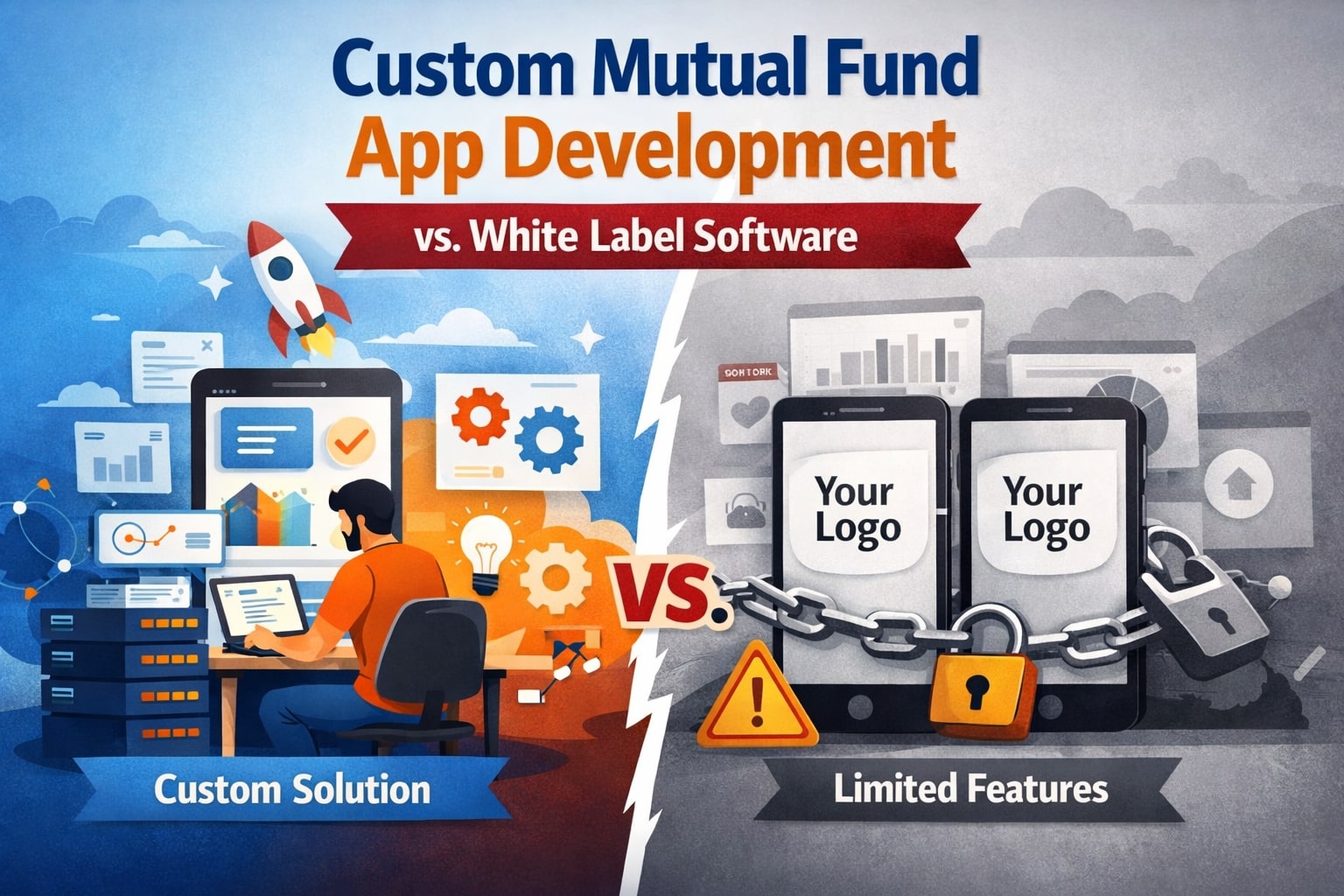
The mutual fund distribution business in India is changing quickly. White-label platforms are cheap and fine to start with, but they tend to fall short once a distributor or RIA grows past a few hundred clients, builds a real sub-broker network, or needs analytics and compliance flows the vendor does not offer.
As investor expectations rise, regulatory requirements tighten, and data sources fragment across CAMS, KFin, BSE, NSE, CKYC and FATCA, more firms are looking at custom-built mutual fund platforms designed around their own workflows, branding and customer experience.
We have shipped custom MF platforms for Findola Capital, Edelweiss Finsens, Edelweiss PHFL, and Paygro, among others. This guide covers what those platforms actually contain, when a custom build pays off over a white-label, and how the architecture comes together.
Does your business actually need custom MF software?
Check everything that applies to you.
Why distributors and RIAs are moving away from white-label.
Operational complexity has grown.
A working MFD today juggles multiple RTAs for transactions and reports, AMC empanelments, multi-family accounts, SIP tracking, goal mapping, compliance reporting, and sub-broker hierarchies. White-label platforms tend to be one-size-fits-all and rarely accommodate the specific shape of a growing practice.
Investors expect a polished digital experience.
Indian investors compare every distributor app against Groww, Zerodha Coin, Kuvera, and the AMC apps. A white-label dashboard with a generic UI looks dated next to those, and a switch is one tap away. A custom investor app under your own brand, with the goal-tracking, alerts and reporting your clients actually use, is increasingly table stakes for retention at higher AUM.
Integrations and data pipelines are becoming the moat.
Custom development gives you direct access to CAMS and KFin file feeds, BSE Star MF and NSE NMF II transaction APIs, KYC and FATCA endpoints, payment gateways, and emerging AI-driven advisory layers. The depth of integration is where the operational advantage compounds. White-label platforms intentionally limit this so they can serve many customers from the same codebase.
Compliance has become too consequential to outsource to a generic tool.
RIAs in particular face real operational pressure: SEBI reporting, suitability checks on every recommendation, proper risk profiling per client, KYC and AML workflows, and clean audit trails that hold up under inspection. Owning the compliance flow rather than fitting into a vendor's template makes the firm safer and the records easier to defend.
The six modules of a custom MF platform.
A full custom mutual fund platform is six integrated modules. Each is meaningful on its own and most engagements start by building two or three before broadening scope.
Identity verification
- CKYC API search to check whether the PAN is KYC compliant or non-compliant
- PAN validation
- Aadhaar or OTP-based eKYC validation
- Nominee details collection
- DigiLocker workflows for PAN and Aadhaar
- NSDL e-Sign
Risk profiling
- SEBI-compliant questionnaire
- Automated risk scoring
- Fund allocation based on risk profile
FATCA and bank verification
- Automated FATCA registration and NSE/BSE sync
- Penny drop for bank account validation
- Mandate registration via eNACH and e-SIP
A custom build lets you decide the flow rather than fit a vendor's UX.
Direct RTA integration with CAMS and KFin enables:
- Lump sum purchases
- SIP registration, modification and cancellation
- Switch orders and redemption flows
- Mandate registration
- Multi-investor family-level execution
The workflows match your team's process rather than a vendor's template.
A custom-built pipeline handles:
- Daily RTA file ingestion from email feeds
- Cleaning, parsing, normalising and mapping files into your database
- Automatic reconciliation of missing transactions
- Folio merging using folio-number heuristics
- Daily auto-update of investor portfolios
The challenges this solves
- Duplicate folios
- Mismatched ISIN data
- Family grouping across folios
- Time lag between RTA feeds and CAS reports
- Multiple ARN books in one practice
Replaces hours of manual back-office work every day.
Where a custom platform genuinely differentiates from a white-label:
- SIP continuity probability score
- SIP status tracking covering pending, failed and paused
- Expected returns projection
- SIP health score per client
- SIP top-up suggestions based on income or goal progress
- Fund rotation alerts
- Underperforming SIP signals
Lets you start the next conversation with the investor before they raise it.
For growing ARNs and multi-branch networks:
- Role-based access for employees
- Hierarchical user management
- Sub-broker dashboards tracking AUM and earnings
- Fund performance and earnings reports
- Target vs achievement tracking for SIPs
- Distributor-wide AUM insights
Hard to do with off-the-shelf software because every practice has its own hierarchy.
A custom investor app under your brand can include:
- Portfolio details with real-time NAV
- SIP tracking with returns
- Goal tracking
- Alerts and market nudges
- Family account management
- Report downloads
- DIY fund research surfaces
Branding, colour, type and UX are yours. Your name on the App Store, not a white-label vendor's.
Custom vs white-label, on the same axes.
| Area | White-label platform | Custom-built platform |
|---|---|---|
| Branding and UI | Generic look, same across distributors | Fully branded to your identity |
| RTA integration | Usually only via BSE/NSE, no direct CAMS or KFin | Direct CAMS and KFin pipelines, full control |
| Analytics | Standard AUM and transaction reports | SIP health scores, churn signals, custom alerts |
| Multi-branch / sub-brokers | Limited or unavailable | Custom hierarchy, role-based access |
| Compliance workflows | Fixed risk profiling, limited audit trails | SEBI-compliant flows built to your process |
| Investor mobile app | Shared generic app if available | Your own app on Play Store and App Store |
| Ownership and roadmap | Vendor decides features and timelines | You own the codebase and the roadmap |
| Data mismatches | No access to fix, raise a ticket | Custom reconciliation logic in your pipeline |
Who actually needs to build custom MF software.
A custom platform makes sense for a specific kind of firm. The list below covers the typical fit:
- Established mutual fund distributors with several hundred active clients and an existing white-label hitting its ceiling
- Growing RIAs that need audit-defensible compliance flows on top of their advisory practice
- NBFCs entering wealth or building a wealth-tech arm
- Fintech startups offering MF distribution as part of a broader product
- AMCs needing a partner or digital distribution platform
- Advisory firms with a research team and proprietary analytics they want to surface to clients
Below the few-hundred-client mark, a white-label platform is usually still the right call. The custom investment only pays off once operations and investor experience start becoming the bottleneck.
Decisions before you start the build.
Scope clarity.
Decide which of the six modules go into the first release. Most engagements start with onboarding plus transactions plus RTA reconciliation, then add analytics, multi-tenant back-office and the investor app in later phases.
In-house team or specialist vendor.
Most firms choose a vendor with prior MF-tech experience to avoid regulatory pitfalls and the cost of running an in-house engineering organisation. The integrations themselves (CAMS, KFin, BSE Star MF, NSE NMF II, CKYC, FATCA, e-Nach, e-Sign) carry enough domain detail that generic dev shops figure it out on the customer's timeline.
Long-term maintenance.
Custom platforms are multi-year commitments. Plan for hosting, monitoring, the security review cycle, and ongoing module work. Most engagements run as a continuous build rather than a one-time delivery.
API readiness.
Decide upfront whether you want NSE NMF II, BSE Star MF, or direct RTA integration. The trade-offs around speed, control and operational overhead matter more than the technology choice.
Regulatory readiness.
Risk profiling, audit logs, mandate management, AMFI rate cards, EUIN tagging on every transaction, GST and TDS on distributor commission, clawback windows. The work involves real domain depth, not just clean code.
The work we have done most.
Custom mutual fund software is the work we have done most of across our practice. Findola Capital is a self-serve mutual fund app live with a lakh-plus downloads. Edelweiss Finsens is a goal-led MF planning app for the Edelweiss group, with Edelweiss PHFL running on the same engine for PNB Housing Finance customers. Paygro wraps every Razorpay-routed bill payment with a mutual fund round-up. Each platform uses the architecture covered in this guide.
If you are weighing a custom build, our MFD Software pillar page covers the productised offering for established Indian MFDs. The commission article covers the operational details around what your platform needs to track, and case studies has the full set of platforms in production.
Building a custom mutual fund platform? Tell us about it.
Tell us about the build. We respond within one business day, and we will say plainly if an off-the-shelf product would serve your book better than a custom one.
Start the conversation